
Why Does a Creator Bother With Us?… Are we worth the trouble?
So, why God would bother redeeming us, even when we’re a mess—Scripture basically says it’s not because we’re worth it on our own. We’re not. Romans three: “There is none righteous, no, not one.” But then comes the twist: it’s all about His love and glory, not our merit. John three-sixteen—He gave His Son not because we earned it, but “because God so loved the world.” Ephesians two calls us “dead in trespasses,” yet He makes us alive “because of the great love with which He loved us.” It’s His character—mercy, grace, and a promise to make everything new. We’re the prize He chose to rescue, not the reason He had to. Kinda humbling, right?
Yeah, it really is. The more you dig into it, the less it feels like we’re the heroes of the story and the more it’s clear God’s the one who won’t let go. Isaiah says He called us by name before we even existed—He chose us not for anything we did, but just because He wanted to. Psalm one hundred three puts it straight: “He does not deal with us according to our sins… as far as the east is from the west, so far does He remove our transgressions.” It’s wild—He doesn’t just forgive; He erases the record and calls us His own. We’re worth redeeming because He says so. That’s the only reason that holds up.
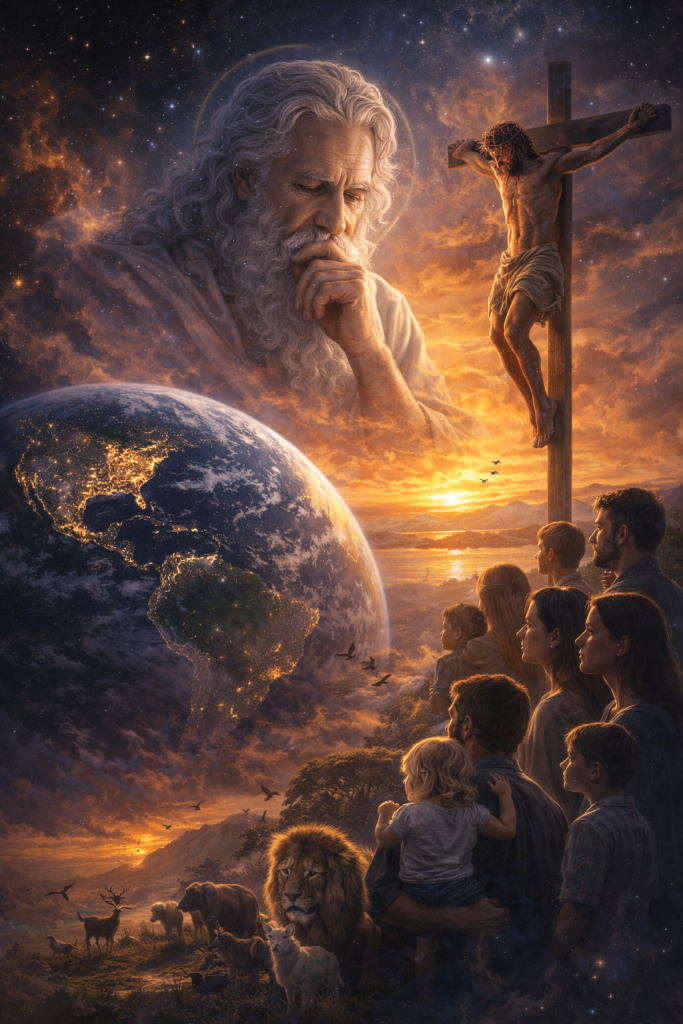
God’s redemptive plan unfolds as the great, overarching story of Scripture—a purposeful movement from creation’s perfection, through humanity’s fall into sin and brokenness, to ultimate restoration and renewal in Christ. At its heart, this is the story of a holy God who loves His creation so deeply that He pursues its rescue at infinite cost.
In the beginning, God created everything “very good” (Genesis 1:31, NASB), with humanity made in His image to reflect His glory and steward the earth. But sin entered through disobedience, fracturing the relationship between God and people, and bringing curse upon the entire created order. Thorns, toil, pain, and death became reality (Genesis 3:16-19). Yet even in judgment, God spoke hope: He promised that the seed of the woman would crush the serpent’s head (Genesis 3:15, NASB), foreshadowing a coming Victor who would defeat evil and reverse the damage.
Throughout the Old Testament, God revealed glimpses of His redemptive intent—through covenants with Abraham, the exodus deliverance, the sacrificial system pointing to a greater atonement, and prophetic promises of a new covenant and renewed hearts (Jeremiah 31:31-34; Ezekiel 36:26-27, NASB). All these anticipated the decisive act of redemption in the person and work of Jesus Christ.
When the time arrived, “God sent His Son, born of a woman, born under the Law, so that He might redeem those who were under the Law, that we might receive the adoption as sons” (Galatians 4:4-5, NASB). Jesus, fully God and fully man, lived a sinless life, died as the perfect sacrifice for sins, and rose victorious over death. Through His cross, God accomplished reconciliation: “For it was the Father’s good pleasure for all the fullness to dwell in Him, and through Him to reconcile all things to Himself, having made peace through the blood of His cross; through Him, whether things on earth or things in heaven” (Colossians 1:19-20, NASB). In Christ, God is summing up “all things in the heavens and on the earth” under one head (Ephesians 1:10, NASB).
This redemption extends beyond individual souls. Creation itself, subjected to futility because of sin, “groans and suffers the pains of childbirth” as it eagerly awaits liberation (Romans 8:19-22, NASB). The same Savior who redeems sinners will liberate the cosmos from decay, bringing it into “the freedom of the glory of the children of God.”
The grand finale arrives at Christ’s return. The risen Lord declares, “Behold, I am making all things new” (Revelation 21:5, NASB). In the new heaven and new earth, God will dwell with His people: “He will wipe every tear from their eyes; and there will no longer be any death; there will no longer be any mourning, or crying, or pain; the first things have passed away” (Revelation 21:4, NASB). Sin, suffering, and separation will be eradicated forever, and God’s original design—perfect harmony between Creator, creation, and creatures—will be gloriously fulfilled.
This breathtaking plan invites response: faith in Christ, repentance, and joyful participation in His kingdom work today.